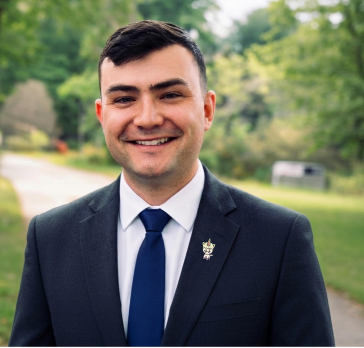
Bridger Smith graduated from Naval Postgraduate School in 2021. He received an outstanding thesis award and the NDIA Rear Admiral Jack Jarabak Bronze Star Award for his contributions to submarine acquisitions and warfare. Developing and deploying software to submarines was foundational to major programs such as Project Overmatch and Project Blue (the Columbia Class ballistic missile submarine’s (SSBN) program office’s digital transformation initiative) DefenseUnicorns recent success and down selection to deploy their Unified Defense Stack onto warships is attributable back to Bridger’s initial thesis. Bridger and Defense Unicorns are in lock step with the Department of War’s mission to deliver capability into the hands of the warfighters and make software a strategic deterrent.
I fundamentally believe NPS is a critical node in the defense innovation ecosystem and provides the opportunities for students to solve the hard problems of modern warfare. I experienced this first hand as a student. While at NPS I focused on the technical possibilities of my research and how it could impact the submarine community. Today, I see NPS as a vital bridge between the tactical layer of military operations and technical feasibility. What excites me most is the ability to leverage a difference-making alumni network and the school's unique research environment to influence real-world acquisition and modernization strategies across the Department of War.
My thesis research focused on developing a lightweight, tactical-edge Platform-as-a-Service and cybersecurity suite for submarine platforms. I use the skillset and tools I learned at NPS for my work at Defense Unicorns everyday. At NPS, I learned how to navigate the constraints of air-gapped systems and the requirements of the DevSecOps pipeline. I was given the resources, support, and mentorship needed to go after this problem space. This experience exposed me to the mission owners and technical teams that are tasked with delivering capability to the warfighters. Translating operational pain points into secure, scalable software solutions that deliver capability to the warfighter is as important today as it was when I was conducting my research.
The conversations at Converge @ NPS are a direct link to real world problems. They repeatedly prove their value because they strip away the usual barriers between the operational community, industry, government, and academia. These interactions create a high-contact density environment where shared challenges, like digital modernization and secure software delivery, are confronted through collaborative problem solving rather than siloed efforts. Multiple conversations I had helped break through current problems and barriers.
It is critical for industry to build impactful relationships and leverage these partnership opportunities. The warfighters have the best knowledge of where operational friction occurs. NPS provides a sandbox for rigorous experimentation and validation. By working closely with NPS, industry partners ensure that their solutions are not just technically sound but operationally relevant and warfighter-vetted. These are the keys to successfully integrate into the unique proving ground of the Department of War.
The NPS mindset fosters a culture of innovation leadership. A warfighter's ability to bridge the gap between technical complexity and operational mission success is how battles are won. NPS students and alumni don't just understand the tools, they understand the environment in which it must operate and the demands it must meet. Their perspective is invaluable. Past, present (and future) leaders converge on campus everyday and bring a level of disciplined, mission-first thinking that balances high-velocity technical experimentation. Few institutions can match the thought leadership and battlefield effects NPS introduces to the DoW with each graduate.