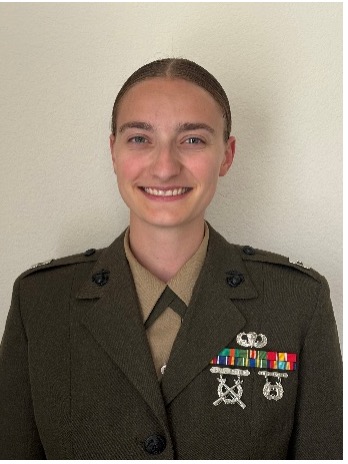
Capt. Evelyn Berecz is a Marine Corps Infantry Officer currently assigned to the Naval Postgraduate School, where she is pursuing graduate studies in Modeling, Virtual Environments, and Simulations (MOVES). She commissioned in May 2021 after earning a BS in Arabic Language and Literature and a minor in German from the United States Naval Academy. Following graduation from The Basic School and the Infantry Officer Course in 2022, she was assigned to 3d Battalion, 7th Marine Regiment (V37) in Twentynine Palms, CA.
At V37, she commanded a line platoon and later served as the Company Fire Support Team Leader, Company Executive Officer, and Assistant Battalion Operations Officer. While with V37, she participated in multiple Service Level Training Exercises and deployed in support of Unit Deployment Program West to Okinawa and South Korea. She was promoted to Captain in 2025. Her academic interests include the use of virtual reality and simulations for training.
Virtual Reality (VR) is becoming an increasingly viable solution for realistic training, but the traditional VR solutions consist of a head-mounted display and a joystick to control movement within the virtual environment. These conditions cause a mismatch between the user’s visual input and their body’s physical input, which can lead to symptoms similar to motion sickness. I am investigating the Virtuix Omni One as a potential solution to reduce these symptoms and as a tool to facilitate training that provides the user with better spatial awareness than the traditional VR set up. The Omni One allows the user to have 360 degrees of motion and conduct a more realistic walking motion. My research will help determine if the Omni One is capable of providing service members with an immersive way to conduct training such as operational rehearsals, land navigation, and search and rescue in a more effective way than traditional VR.
Events like Converge help bridge the gap between students, who understand the current operating environment and industry partners who have the expertise and means to help solve current issues. The nature of the event allows students to make more personal connections with industry partners and really dive into the projects being presented. Converge can give students a more tangible direction for thesis research and projects as they are able to learn about current projects and priorities.
The ability to conduct live demonstrations with the Virtuix Omni One and have attendees play through a simple game really helped me highlight the potential benefits of the technology. Many of the attendees at Converge are familiar with VR and its current benefits and limitations. The addition of having the physical device at the event and having attendees try it out lead to a lot of interesting conversations about its potential advantages and uses across the Joint Forces. As Converge aligned with the NPS International Alumni Symposium, I also had the privilege of discussing my research with NPS Alumni from partner nations who were also interested in the benefits of this research.
The conversations I had with key leaders reinforced the impact that our research can have beyond the NPS campus. The Virtuix Omni One has potential to be an impactful training tool that could enable service members to train in diverse environments across a range of mission sets in areas with limited training space or resources. I was surprised by the amount of interest from industry partners and military leaders.
Based on my experience in the MOVES program, there is a lot of flexibility in choosing a thesis topic. Some students have identified issues or gaps they want to address as a thesis topic prior to arriving at NPS and others find a topic along the way. The faculty in the MOVES department is very skilled at helping students shape their ideas into Master’s level research. Our military faculty also helps guide students towards operational problems and helps us understand the bigger picture for the operating force.