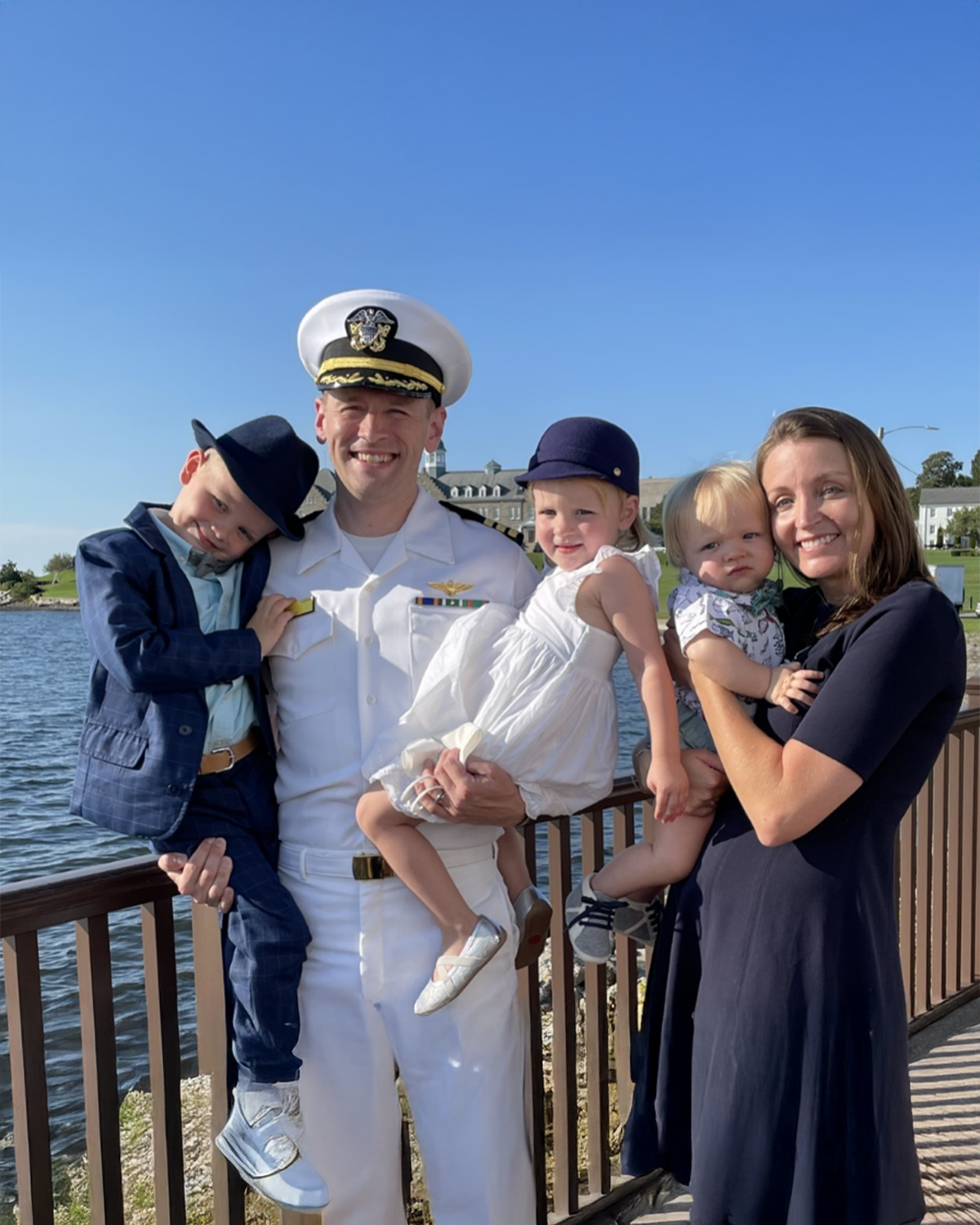
CDR Berdahl hails from Lawton, MI, and currently lives with his family in Carmel Valley, CA. He is pursuing a PhD in Applied Physics at the U.S. Naval Postgraduate School and, upon completion of his degree, will transition to the faculty, where he will teach in the Space Systems Academic Group and the Physics Department.
Previously, CDR Berdahl served as an F/A-18 and EA-18G test pilot with combat experience in Afghanistan and Iraq. He has accumulated nearly 2,000 flight hours in more than 25 different aircraft types. Additionally, he served as a war game developer at the Naval War College, where he built and facilitated CNO-directed war games.
Jens enjoys travel, reading, the outdoors, gardening, mycology, and spending time with his wife, Christine, and their three children: Sven (10), Anneli (7), and Leif (5).
Serving on that panel was genuinely a privilege. I was sitting alongside three exceptional leaders — VADM Mike Vernazza, RADM Todd Alexander, and Rob Lehman from Saronic — and each brought a distinct perspective shaped by their own experiences across operational, strategic, and industry domains. I’ve always been fascinated by how leaders think and approach problems, because if you want to understand an organization or even a nation, understanding how its leaders reason through challenges is incredibly revealing.
What stood out most to me was the alignment around urgency — the recognition that technological competition is accelerating and that our institutional processes must evolve with it. Rob’s comments about allowing sailors to pursue “side quests” particularly resonated with me, because they capture something fundamental: innovation often emerges from motivated individuals who are given permission and space to explore.
Beyond the panel itself, some of the most enlightening conversations happened before and after, when we could engage more directly. Those exchanges reinforced how valuable it is to bring together leaders from different sectors who are all focused on solving hard problems for national security.
If we are serious about moving faster than our adversaries, then funding and organizational flexibility are not administrative details — they are strategic weapons.
Our greatest asymmetric advantage is human capital. The Navy is filled with talented people who generate ideas every day, but ideas alone are not enough. What matters is whether those individuals have the freedom, resources, and authority to act on those ideas. Innovation happens at the intersection of creativity and empowerment.
We should also be willing to ask fundamental questions: should every organization in the Navy have the same structure? Should every career path be managed the same way? Different missions demand different approaches, and leaders who enable flexibility — like creating space for sailors to pursue those “side quests” — unlock tremendous potential.
Funding flexibility is equally critical. Constraints like one-year and two-year money are largely self-imposed limitations that slow progress. When the right person has the right idea at the right time, delays in funding alignment can cause opportunities to disappear. How many innovations have been lost because support wasn’t available when momentum existed?
Institutions like the Naval Postgraduate School and the Naval Postgraduate School Foundation demonstrate what becomes possible when you empower people and reduce friction. They provide protected space for exploration, collaboration, and calculated risk-taking. That innovative spirit is illustrative of what the Navy could achieve more broadly if we intentionally designed systems to unlock, rather than constrain, our people.
The core problem I was surfacing at Converge is that quantum sensing development is constrained by extremely large design spaces and expensive, hardware-intensive experimentation. Iterating purely in the physical world is slow and costly.
The digital twin platform we’re developing changes that paradigm. By building a high-fidelity virtual representation of quantum sensors and their environments, we can explore configurations, optimize designs, and predict performance before hardware is built. That dramatically accelerates development timelines.
What makes this especially powerful is the collaboration model. We’re seeking partnerships in three areas:
The vision is a shared ecosystem where multiple partners contribute to training the digital twin and all participants benefit from the resulting predictive capability. Importantly, this model can respect intellectual property while still enabling collective progress. That’s what makes this approach unique — it allows us to work together across an astronomically large parameter space that no single organization could realistically cover alone.
Ultimately, this is about creating a new way of collaborating between government, academia, and industry.
One of the most remarkable outcomes from Converge was how quickly meaningful connections formed. Within a very short period after a brief pitch, I found myself connected to senior points of contact at some of the largest and most respected technology organizations in the country. That speaks to the power of the environment that Converge creates.
We’ve already established verbal agreements related to potential funding and have several promising partnerships developing. This type of research is expensive, and funding directly influences how quickly we can move. But equally important are the relationships with people working on adjacent or complementary problems.
For training our models, we need both breadth and depth — across elements, isotopes, configurations, and operational contexts. Casting a wide net strengthens fidelity. The relationships formed through Converge position us extremely well for that.
Frankly, the outcomes exceeded anything I could have predicted, and we’re excited to move forward with partners who see the same potential we do. We believe we have something meaningful to offer, and we look forward to going on this quantum sensing journey together.
I’ve always believed the true measure of a conference isn’t what happens during the event — it’s what happens three days later when everyone returns to their day jobs. If nothing changes, the conference probably wasn’t as impactful as we hoped. But if new teams are forming, collaborations are emerging, and momentum continues, then it was successful.
That’s what I’ve seen with Converge. It’s not just conversation — it’s action. Teams are forming, gaps are being filled, and people are continuing to work together.
The recurring nature of the event also matters. Having regular touchpoints — like the January session followed by another planned gathering in July — keeps relationships alive and maintains momentum. Innovation is rarely a single event; it’s an ongoing process built on trust and repeated engagement.
At its core, quantum sensing is about measuring things with extraordinary precision by leveraging the fundamental properties of atoms and light. That increased sensitivity can translate into operational advantages such as navigation without GPS, improved detection capabilities, or more accurate timing and positioning.
What matters operationally isn’t the physics — it’s the outcome. If we can provide warfighters with reliable information in environments where traditional systems are degraded or denied, we increase both effectiveness and resilience.
In contested environments, quantum sensors could provide entirely new options. But, to revolutionize the quantum sensing field, we need to make some thoughtful changes to how we do business. In the end, technological advantage isn’t just about inventing new hardware — it’s about designing institutions that allow talented people to move at the speed of relevance.