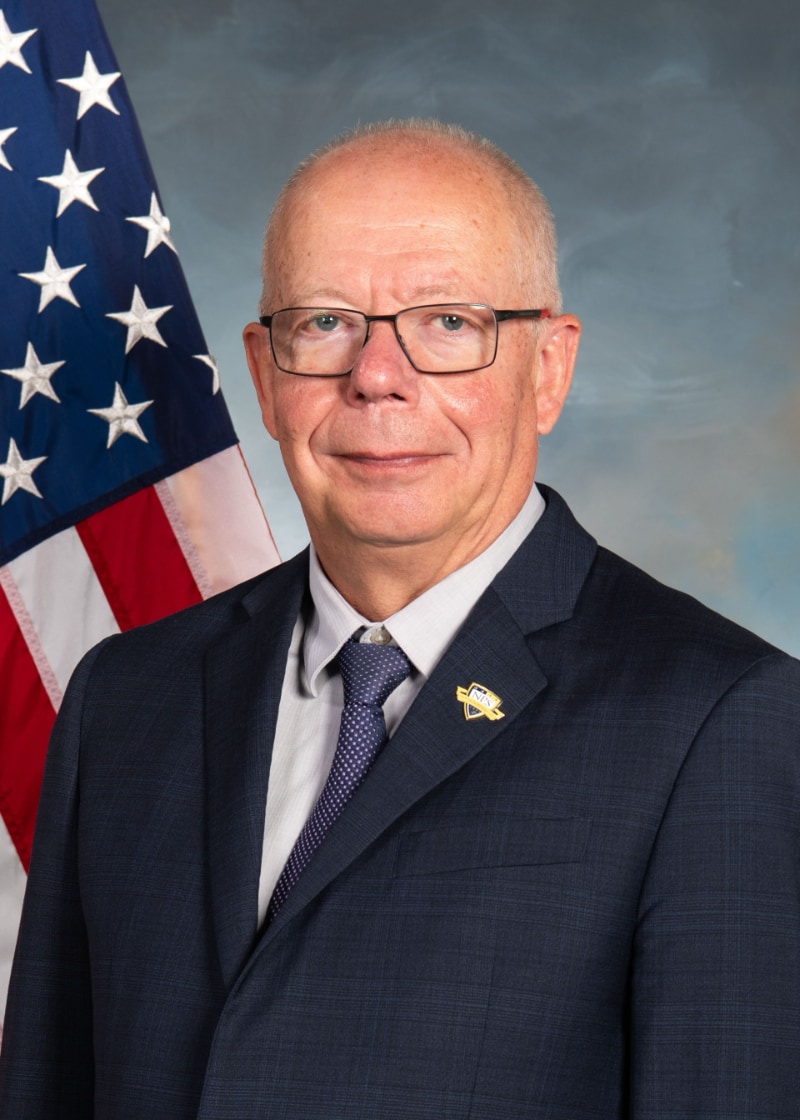
Dr. Michael Hesse serves as Vice Provost for Research and Innovation (VPRI) at the Naval Postgraduate School (NPS), where he provides strategic leadership for the university's research enterprise. In this role, he oversees the development and execution of research priorities that advance the Navy, Marine Corps, and Department of Defense. He directs efforts to expand interdisciplinary collaboration, foster partnerships with government, industry, and academia, and support faculty and student innovation. Dr. Hesse also plays a central role in advancing the Naval Innovation Center at NPS, aligning cutting-edge research with operational challenges to accelerate solutions for national security.
Prior to coming to NPS, Dr. Hesse was the Director of the Science Directorate at NASA's Ames Research Center, a position in the Senior Executive Service. Before joining Ames, Dr. Hesse had a distinguished 25-year career at NASA's Goddard Space Flight Center (GSFC), culminating in his role as the Director of the Heliophysics Science Division, a Senior Executive Service position. Dr. Hesse was also the founding Director of the Community Coordinated Modeling Center (CCMC), the world's foremost organization providing unprecedented comprehensive modeling services to the international space science community.
Dr. Hesse remains a publishing research scientist in space science and space weather, with more than 300 papers in the scientific literature, and an H index of 75. He was elected Fellow of the American Geophysical Union in 2010, he received NASA's Outstanding Leadership Medal in 2007, and NASA's Distinguished Service Medal in 2017. In 2023 he was recognized by the Meritorious Presidential Rank Award for Senior Executives. Dr. Hesse received his diploma and doctoral degree in Theoretical Physics from the Ruhr-Universität in Bochum, Germany.
I have known NPS through my NASA work, both at Goddard Space Flight Center, and at Ames Research Center. NPS has impressed me as an organization that combines forefront education with world-class research, all targeting something very dear to my heart: National Defense. Here, as in my prior positions, I see research and innovation as a critical necessity and also a tremendous opportunity. We need research excellence to take our warfighter education to the very forefront of knowledge, to make them critical thinkers and excellent decisionmakers in their future career. Our research and innovation thrive when focused on relevant applications in the Fleet and beyond – just as NASA research focuses on NASA needs and goals. This is our north star, and my goal is to nurture, support, and incentivize it.
Going beyond my personal emotions as a former NASA leader, Artemis II is an inspiration for all, NASA, the Country, and the entire world. It shows what dedication, focus, and inspiration can accomplish at the highest level. Artemis II is a huge step to humanity’s destination: the moon. Our national goal is to lead the world to establish permanent residence there, expanding human presence beyond Earth. Looking farther out, the experience, technologies, and lessons learned in lunar exploration will be invaluable as we look toward the next objective: the planet Mars.
Naturally, we at NPS are tremendously proud that two of our alumni served on the mission, adding to the more than 40 astronauts educated at NPS. Reid Wiseman and Victor Glover are the latest very visible example of leaders shaped by NPS education. NPS is focused on conveying knowledge and analytic skills that are key for future leaders, whether they become senior military officers, or astronauts. This education has been exceptionally successful for many decades and through many changes – a testament to the quality of research and education here at the School.
NPS student experience and background is absolutely essential to all the research and development work we are doing here. Together with the advisors, students define and shape their research projects so that they are relevant for the operational environments the students come from. This direct input ensures that research remains grounded in real-world needs. In many cases results will therefore make it to applications, whether they are under water, on the surface, in the air, or in space. Lastly, as the students move on to their next deployment, they take that knowledge with them, making them highly effective capability users and decision-makers. This is the second part of the dual transition to operation of NPS research: through the development itself, and through the brains of our students.
Connections to organizations like NASA, other government labs, academia and industry are fundamental to stimulating first-rate research, to execute research in partnerships, and to bring research to the end user. NPS can point to a long list of exceptionally successful partnerships – a list that continues to grow. Because research excellence is required for education at the forefront of knowledge, these linkages also support education very strongly. Partnering is therefore critical to NPS mission success in developing the next generation of leaders, and in conducting forefront research.
The Naval Innovation Center is a key enabler for connecting NPS with sponsors and partners in a focused, mission-driven way. It brings together operational problems, faculty expertise, and student experience in a focused, mission-driven way to accelerate the development of relevant solutions. Initiatives such as the Digital Trident AI Challenge and Converge @ NPS operate within this framework, creating structured opportunities to engage partners and rapidly move from problem definition to prototype. By anchoring these activities, the NIC strengthens both research and education, ensuring alignment with real-world needs while preparing students to translate innovation into operational impact.