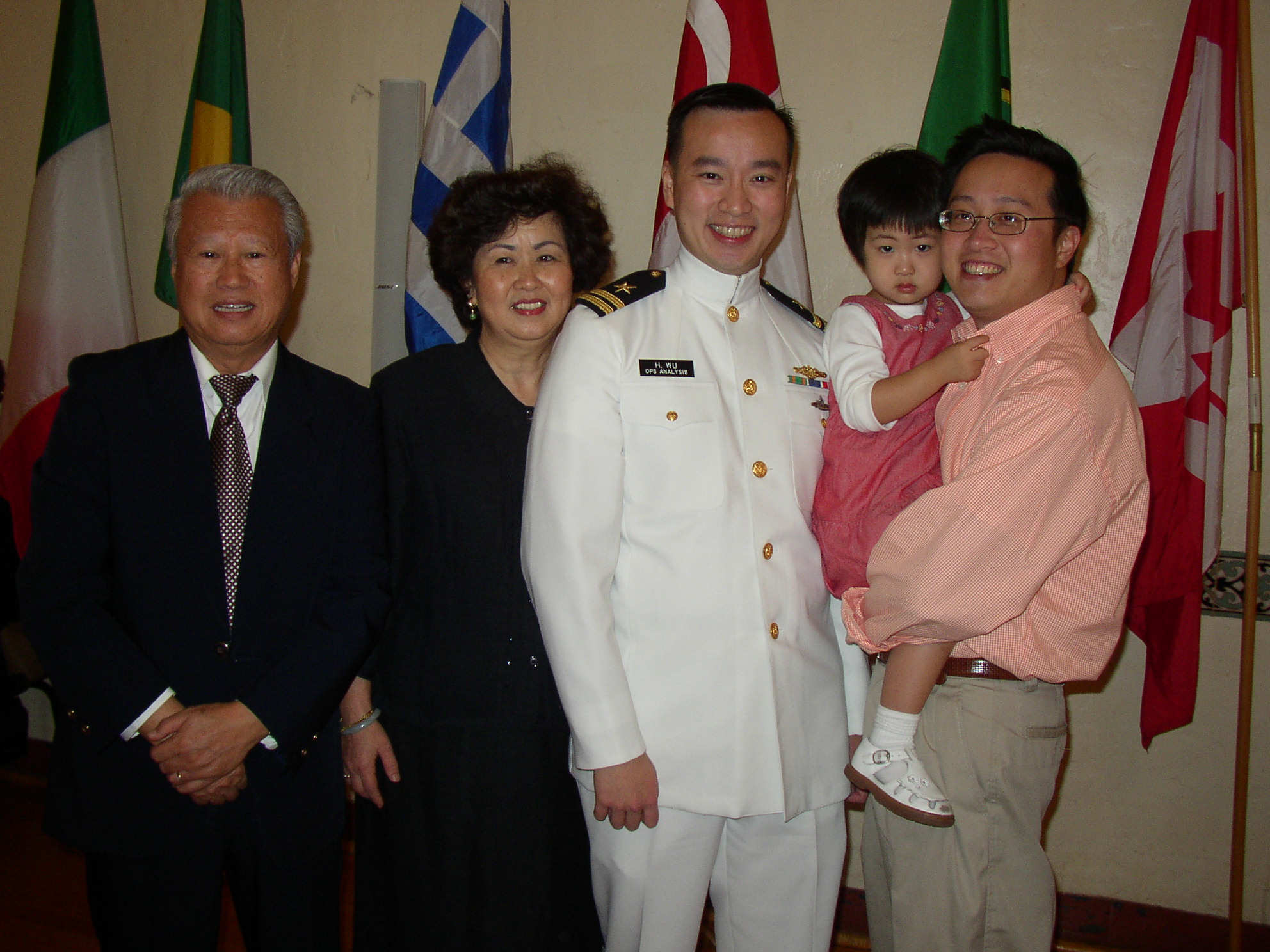
Hsin‑Fu “Sinker” Wu is a Technical Fellow in Systems Engineering at Raytheon, an RTX Business, where he leads mission‑level operations analysis that informs requirements and capability development in the undersea and maritime domains. He brings more than a decade of aerospace and defense industry experience analyzing advanced naval warfare concepts and improving customer mission solutions through system‑of‑systems modeling, simulation, analysis, and mission engineering, supporting the design of the future fleet.
Sinker is also a co‑Principal Investigator for the RTX–Naval Postgraduate School Cooperative Research and Development Agreement in Aerospace and Defense Technologies for Naval Research and Development. His research includes ethical control of autonomous systems and metrics development for Artificial Intelligence (AI) ethics, advancing AI assurance in human‑machine teaming for distributed maritime operations.
Before joining Raytheon in 2015, Sinker completed a 20‑year career in the U.S. Navy as a Submarine Warfare Officer and Foreign Area Officer. His staff assignments included tours at Headquarters Department of the Army; United Nations Command Military Armistice Commission; and the headquarters of U.S. Pacific Fleet and Submarine Force. His operational assignments included Combat Systems Officer on USS JIMMY CARTER (SSN 23), Assistant Weapons Officer on USS GEORGIA (then SSBN 729) (GOLD), and division officer on USS HENRY M. JACKSON (then SSBN 730) (BLUE).
Sinker holds a B.S. in Aerospace Engineering from the University of Kansas, an M.S. in Operations Research from the Naval Postgraduate School, and Joint Professional Military Education (Phase I) certificate from the Naval War College. He is fluent in Chinese and has served as a translator and interpreter for both the U.S. Navy and Raytheon, supporting leadership engagements that benefit from cross‑cultural and multilingual expertise.
I attended NPS from 2000 to 2002. During my first year, I was focused on schoolwork and enjoying Monterey. I appreciated the NPS Foundation’s involvement in community service activities, but at that time my understanding of NPS’ broader role in national security was fairly limited. As a Submarine Warfare Officer in the Operations Research (OR) curriculum, my interests were centered on Submarine Warfare and OR. And although I heard about the award‑winning defense‑relevant theses recognized during graduation at the end of each quarter, it wasn’t until later that I fully appreciated the impact NPS faculty and student research can have on national security.
September 11th, 2001, amplified for me the role NPS plays in national security. I recall that a couple of NPS professors were called on to support operations shortly after that tragic day and returned a few weeks later. The immediate need for their expertise reinforced how NPS contributes to solving real‑world operational challenges. It also motivated me to choose a thesis topic that would make a meaningful contribution—data analytics that could help decision‑makers and warfighters make timely, informed decisions about problems with many factors and complex interrelationships. More than two decades later, learning how Admiral McRaven’s thesis on “The Theory of Special Operations” informed his leadership in planning and executing Operation Neptune Spear further highlighted how NPS warrior‑scholars can shape national security and operational outcomes.
Another dimension of NPS’ impact that became increasingly meaningful in my Navy career was its contribution to security cooperation. I had gotten to know military officers and defense officials from Allied and Partner Nations who were my classmates or who attended short courses on campus. I stayed in touch with a few of them, but it wasn’t until I served as a Navy Foreign Area Officer (FAO) that I realized how valuable those connections were to national security. During my FAO assignments, some of my counterparts were NPS alumni, and knowing we shared the same alma mater helped us build trust and work more effectively together.
As an industry partner and a co‑principal investigator of the RTX‑NPS CRADA, my perspective and appreciation for NPS’ role in national security have expanded even further. I appreciate the clarity and direction provided by the NPS Strategic Framework priorities in Education, Research, Innovation, and Institution. They help me articulate to my leadership the specific ways NPS contributes to national security and distinguishes itself from other graduate education and research institutions. I especially value the Foundation’s efforts to connect government, academia, and industry to the defense‑focused research and innovation ecosystem that extends from NPS.
What excites me most now is the ongoing transformation at NPS as it takes on an even more significant role in national security than when I was a student more than twenty years ago. I’m impressed by the interdisciplinary research groups, the distance learning programs, the annual Warfare Innovation Continuum Workshops, and the multiple ways industry partners can collaborate with NPS. I’m especially excited about the Navy’s plan to build the Naval Innovation Center at NPS. It will be a powerful venue to accelerate research, innovation, and the transition of new warfighting capabilities to the Fleet, and I look forward to opportunities for collaboration through the NIC.
I am very grateful to be a practitioner of Operations Research (OR) in my current role. The OR education I received at NPS has stayed with me throughout my follow‑on assignments in the Navy and in my roles at RTX. I find myself applying several enduring principles nearly every day. A few lessons, in particular, have had a lasting impact:
• Define the problem. Problems are often presented in ways that obscure their true root causes. I rely on OR disciplines—defining, decomposing, and structuring a problem—to clarify what is really happening and to determine the right methods to address it.
• State and check assumptions. My NPS professors reinforced the well‑known George Box proverb: “All models are wrong, but some are useful.” It’s a reminder that every model has limitations and that assumptions shape how a problem is understood. Explicitly identifying assumptions—especially the implicit ones—helps avoid bias, keeps the analysis grounded, and maintains a healthy questioning attitude.
• A partial answer is sometimes better than no answer. This lesson has served me well in the Navy and at RTX, where timely decisions matter. As an analyst, it is easy to fall into “analysis paralysis,” but a timely, good‑enough answer can be far more valuable than a perfect answer delivered too late.
• Consider the whole problem. OR taught me to view each problem holistically. Understanding the full set of contributing factors and their relationships provides deeper insight and leads to more effective models and solutions.
These lessons continue to guide me in how I approach complex operational and technical challenges at RTX. They help me support decision makers, collaborate across teams, and communicate timely and effectively to deliver solutions that are both analytically sound and operationally relevant.
The enduring principle behind the RTX–NPS CRADA has remained the same since the beginning: a shared focus on strengthening defense education, accelerating research impact, and fueling innovation for the Fleet. This foundation aligns closely with the NPS Strategic Framework priorities. Consistent with that shared focus is the purpose of the CRADA itself—an aligned, sustained, and mutually beneficial collaboration to advance aerospace and defense technology research and development. As CRADA partners, I believe we are most successful when we work in areas that draw on the unique strengths of each institution and set us apart from other organizations and partnerships.
Since Submarine Warfare is one of my professional qualifications, I am especially excited about opportunities for RTX and NPS to collaborate in Undersea Warfare. The NPS Undersea Warfare Academic Group (USWAG) was the first forum where early discussions occurred that eventually led to the original CRADA between Raytheon and NPS. Undersea Warfare challenges are inherently interdisciplinary, and USWAG’s cross‑department structure positions it well to develop holistic, interdisciplinary solutions to operational challenges in the undersea domain. I would welcome the opportunity to identify an Undersea Warfare topic of mutual interest to pursue through collaborative research.
As I consider the NPS Warfighting Development Areas, I am also excited about the potential for collaboration in Contested Logistics, Non‑Traditional Sea Denial and Maritime Domain Awareness, and Naval Operational Architecture. These are areas where RTX and NPS can bring complementary strengths, and I believe they offer tremendous potential for impactful, mission‑focused research in the years ahead.
Classified research into potential solutions for operational challenges is one of the most compelling reasons for defense industry collaboration with NPS. The classified research environment at NPS—its secure facilities, faculty and students with active security clearances, and students with operational experience on combat and weapon systems—is a unique strength. These capabilities differentiate NPS from other postgraduate education and research institutions and significantly enhance the value and impact of the RTX–NPS partnership.
Based on my experience, Converge@NPS offers a holistic venue for defense research and innovation. The NPS Foundation brings together participants from across the defense research and innovation ecosystem—industry, government, academia, NPS faculty and staff, and operational commanders and units. When these groups converge at NPS, the new and renewed professional connections and conversations help contextualize potential solutions within the realities of the operational environment and reduce the risk of overlooking key stakeholders in solution development. These interactions often lead to clearer problem framing, insights into second‑ and third‑order effects of potential solutions, early identification of operational constraints, and discovery of complementary research already underway across the ecosystem.

What makes these conversations valuable is the effect they have on the participants. They facilitate mutual understanding across diverse perspectives and stimulate collaboration toward a shared focus: accelerating the development and adoption of solutions to operational challenges. When these groups come together, we often see tangible benefits—for example, aligning industry prototypes with operational needs earlier in the development cycle, connecting NPS faculty research with real‑world use cases, linking large industry primes with emerging startups, and helping government sponsors identify transition pathways that might otherwise be missed. I also believe the exchanges at Converge@NPS promote healthy, constructive competition among industry peers, further advancing innovation.