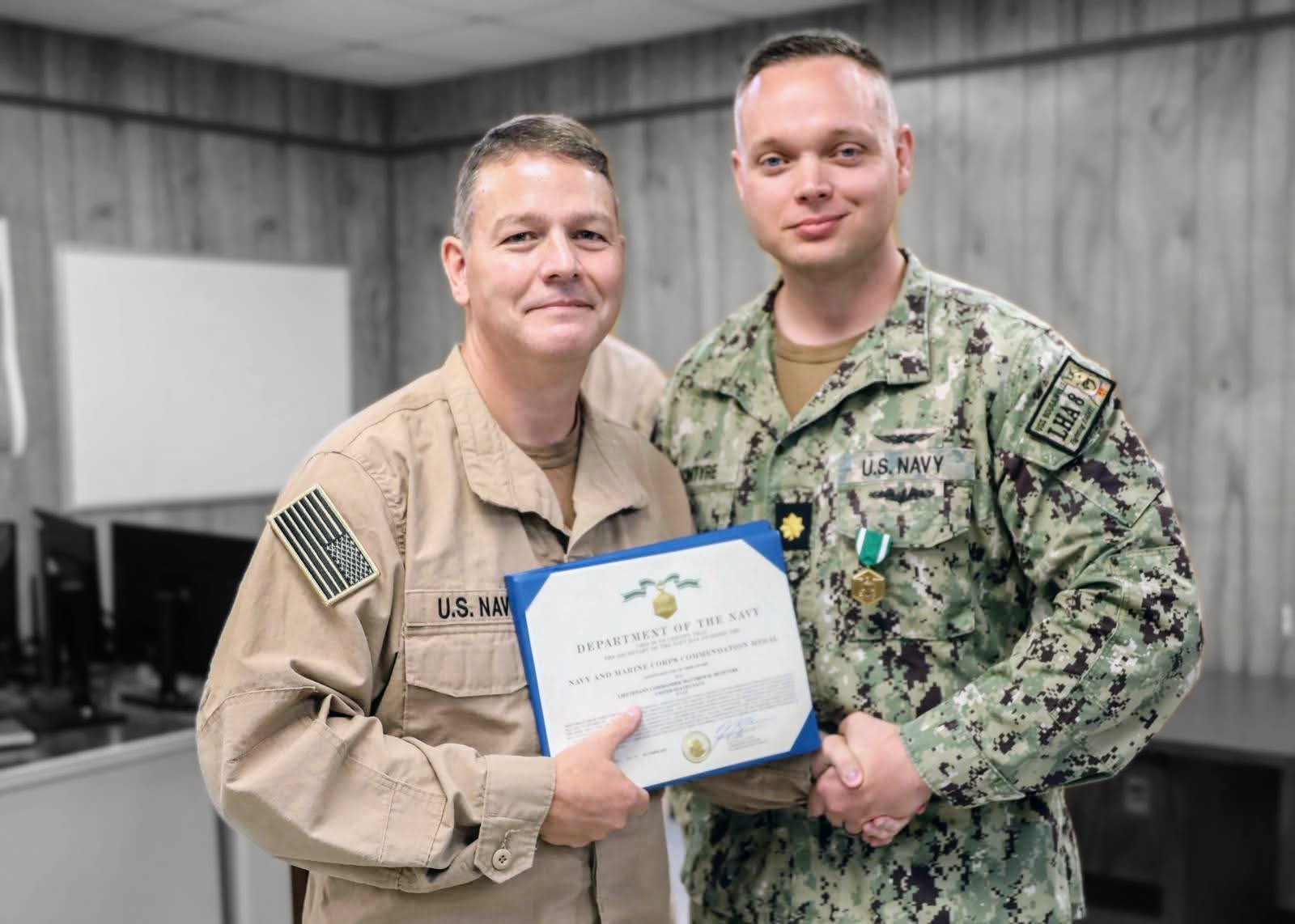
LCDR Matt McIntyre is a native of Gainesville, Florida and currently resides with his family in Monterey, California. He holds a B.Sc. in Physics from the University of Florida, where he gained research experience in Experimental Particle Physics, and is currently pursuing an M.Sc. in Operations Research at the Naval Postgraduate School.
Previously, he served as the Principal Assistant for Logistics (PAL) and Stock Control Officer aboard PCU Bougainville (LHA 8). His prior tours also include serving as the Supply Officer aboard USS West Virginia (SSBN 736) Blue Crew, and as Deputy Director at NAVSUP FLC Norfolk – Groton Detachment, supporting Virginia and Columbia-class submarine PCUs.
Outside of his professional and academic duties, he enjoys reading, amateur radio, and building computers. Above all, he values spending quality time with his wife, Michelle, and their two children, Matt 2.0 (6) and Mikhala (4) - who both love doing science experiments, helping Dad build his high-performance computing homelab, and engineering “Golden Gate” bridges out of whatever materials they can find.
For me, it was seeing firsthand the expansive cross-discipline impact that AI has had in unique applications that I had never even conceived of. We tend to discuss AI in a limited context, focusing heavily on the transactional interactions with Agentic AI and LLMs in our daily workflows and operations, but NVIDIA GTC solidified for me that the future of AI, its underlying mathematics, and the technological infrastructure to support it, extends far beyond that.
I’d say that my biggest surprise came from the ongoing efforts to merge Quantum Computing with AI, and how far they’ve advanced in just a few years.
I approach this technology from a highly multidisciplinary perspective, drawing on my foundation in physics from the University of Florida, my practical RF experience as an Extra Class amateur radio operator, and my hands-on experience building my homelab for GPU parallel computing. Now, as a student in the Operations Research program at the Naval Postgraduate School, I envision an incredibly wide range of applications where these domains intersect.
Lately, I’ve been actively developing my skills in GPU parallel computation using CUDA (the underlying engine powering AI), strongly motivated by my experience in the “Scalable Scientific Computing” course taught by Dr. Lucas Wilcox in the Applied Mathematics Department. I am eager to apply these skills within Operations Research, potentially by accelerating complex numerical methods in simulations for a future thesis topic! Beyond CUDA level programming, I see massive potential in using tools like NVIDIA CuOpt to solve complex optimization problems. Coupled with the insights provided by Agentic AI (as I learned during one of the training sessions), we could greatly accelerate the pace of problem solving without sacrificing solution quality.
Beyond NPS, I believe that there is enormous potential to support not just organic development within the military, but resource-conscious innovation. One concept I am exploring leverages the reutilization of legacy equipment and decommissioned infrastructure to create highly configurable, deployable, and expendable battlefield compute modules. These could drive frontline Agentic AI and a myriad of other tactical applications. Ultimately, I believe that asymmetric advantage comes from both bleeding-edge technological superiority, and the capability to use yesterday’s technology in advanced and unconventional ways.
The value of participating in NVIDIA GTC cannot be overstated. It offers immense professional development through direct interaction with the industries dedicated to supporting our mission, alongside the personal growth that comes from opening your mind to a world of possibilities and new technologies.
My primary advice for anyone who has the opportunity to attend can be summarized in two words; plan ahead! NVIDIA GTC is packed with training sessions, talks, demonstrations, not to mention startup booths, research poster corridors, and other hidden gems. If you’re a dedicated polymath like me, you’ll have a challenging time balancing your diverse interests subject to the constraints of a single conference day. I highly recommend getting their early each day (staying local if possible), bringing your laptop for hands-on-training, wearing comfortable shoes (because there will be plenty of walking). Finally, communicate early with your professors well in advance if you know you have the opportunity to attend. My professors were absolutely amazing and supportive of my participation in NVIDIA GTC and I am extremely grateful for their backing.