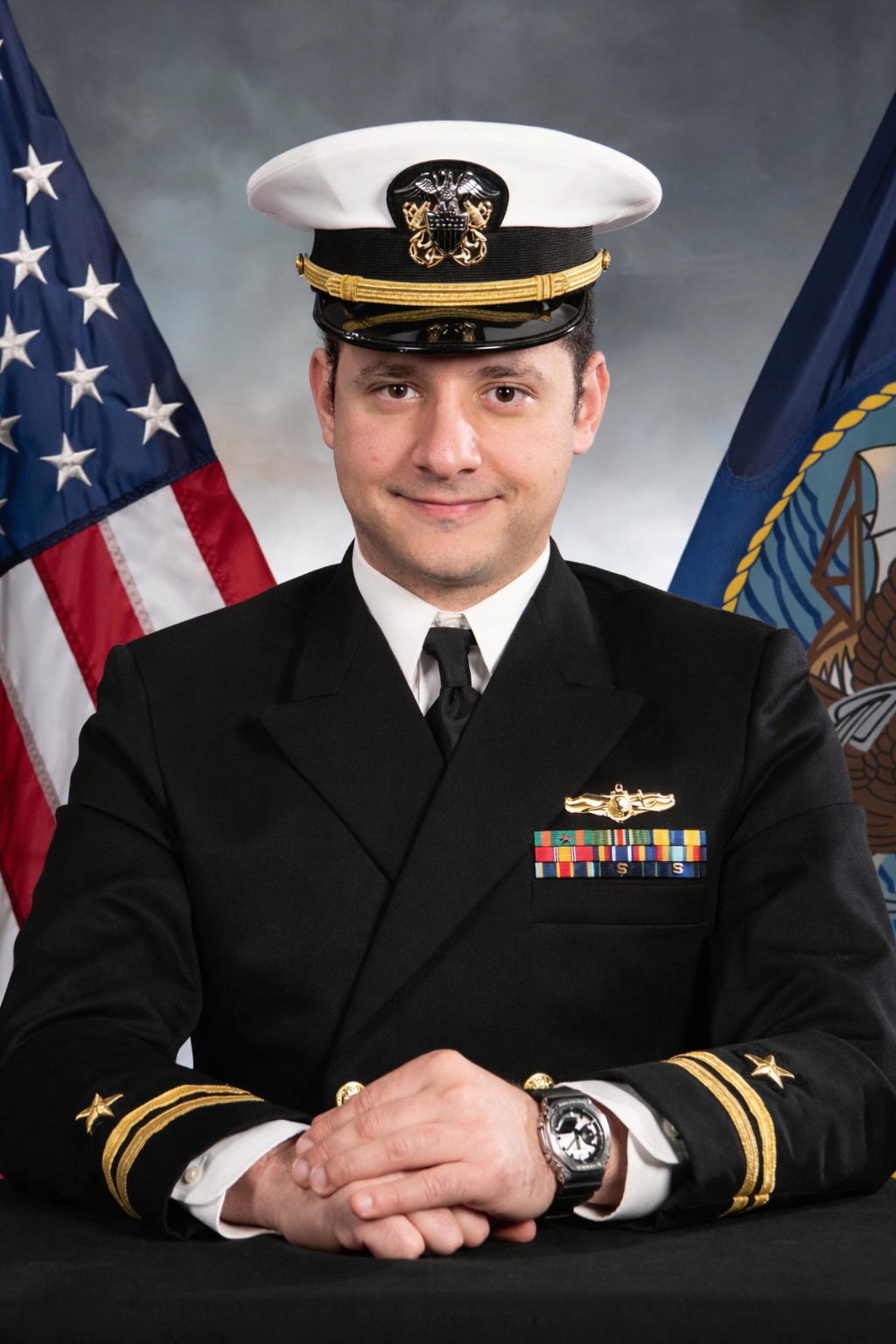
LT Berk Cekli is a native of Fort Lauderdale, Florida. He graduated from Florida Atlantic University with a Bachelor of Business Administration in Management Information Systems and was commissioned through the United States Navy’s Officer Candidate School as an Information Professional Officer.
Prior to earning his commission, LT Cekli worked in South Florida’s maritime industry, serving as a dockmaster for several marinas in the yachting sector. This early experience managing complex waterfront operations fostered his interest in maritime systems, logistics, and communications a foundation that continues to influence his operational and academic pursuits.
At sea and ashore, LT Cekli has served in key communications leadership roles. As Communications Officer at Naval Computer and Telecommunications Station (NCTS) Naples, he supported operations across the U.S. Sixth Fleet area of responsibility and conducted underway communications support aboard USS Mount Whitney (LCC 20). He later served as the Cyber and Communications Officer aboard USS Gridley (DDG 101), participating in multiple major exercises including RIMPAC and numerous Pacific underways, ensuring resilient, mission-ready C4I capabilities in contested environments.
LT Cekli is currently pursuing a Masters in Network Operations and Technology. His research centers on the operational employment of 5G-enabled military communications architectures to enhance sensing, targeting, decision support, and combined maritime operations. His work integrates emerging technologies such as edge computing, AI-enabled decision systems, and resilient C3 frameworks to support distributed maritime operations in future high-end conflict.
Upon graduation in June, LT Cekli is slated to report to Mayport, Florida, where he will serve as Fourth Fleet Communications Officer.
The most impactful aspect of my time at NPS has been the ability to combine operational experience with academics. NPS doesn’t just teach ideas it allows students to experiment with emerging technologies like 5G, AI, and edge computing in ways that directly map to real world operational problems. Working with those in my COHORT and combining everyone’s experiences through projects and experiments has been eye opening. Combining policy, engineering, and operational strategy has changed how I think about capability development. Instead of viewing technology as a tool, I now see it as part of an integrated system covering all expects of acquisition, cybersecurity, and mission effectiveness.
A 5G-enabled C3 model improves maritime mission performance by reducing latency, increasing bandwidth, and enabling distributed decision making at the tactical edge. Further expansion comes from operating in denied environments and using its limited range as a positive to help evade long range detection. In practical terms, this allows manned ships, unmanned surface vessels, UAVs, and shore-based command centers to share ISR data in near real time. Instead of routing everything back to a centralized node, edge computing combined with 5G allows localized processing and faster targeting cycles. For the future fleet, this matters because we are moving toward distributed maritime operations. Smaller, more agile platforms must operate collaboratively across wide areas. Without resilient, low-latency connectivity, that model breaks down. 5G helps enable that distributed, AI-supported force structure.
The upcoming Monterey Bay experiment involves testing the 5G-enabled communications payload on the NPS buoy in partnership with AT&T. The 5G connections has not been used in experiments before and I am hoping to open the path for future students. The objective is to evaluate how 5G can support maritime sensing and resilient offshore communication nodes. We are testing latency, throughput, and reliability of 5G in a maritime environment which has not been formally tested before. This presents unique challenges such as sea state, weather, salinity, movement, and RF propagation variability. What we hope to achieve is proof-of-concept validation that offshore 5G nodes can support distributed ISR, autonomous systems, and near real-time data transfers. We will be using the NPS vessel to head out and test signal at different ranges and conditions to measure changes in throughput and reception. The value of working with industry partners is paramount. Industry moves faster in commercial 5G development, and by partnering early, we reduce transition time from experimentation to operational capability. It also ensures interoperability with commercial infrastructure that the Navy may leverage in future conflicts.
My goal is to leave behind a validated experimental framework and data set that sets future maritime 5G integration efforts. I want this research to move beyond theory and contribute directly to operational capability development. For NPS to build on this work, the next steps could include expanded sea trials, integration with unmanned surface and aerial systems, and testing contested spectrum scenarios. I hope to leave some groundwork for the AI piece in terms of using a language model for data analysis and providing threat detection in the feeds, I think the biggest development will come here. Continued collaboration with industry and fleet stakeholders will be critical. I know from my engagements with industry and leadership the long-term vision is for NPS to serve as a live experimentation hub for secure maritime networking concepts.
Events like AFCEA provide a critical interface between operators, researchers, acquisition professionals, and industry leaders. For us students, it offers exposure to the latest technologies and strategic priorities shaping the fleet. It also allows us to validate whether our research aligns with real-world capability gaps. For the defense community, student research often provides early-stage experimentation and conceptual exploration that industry can help mature. Furthermore, engagements with the SECNAV and CNO are vital to see the vision and future goals. In a rapidly evolving threat environment, collaboration across academia, industry, and the fleet is not optional it’s essential.