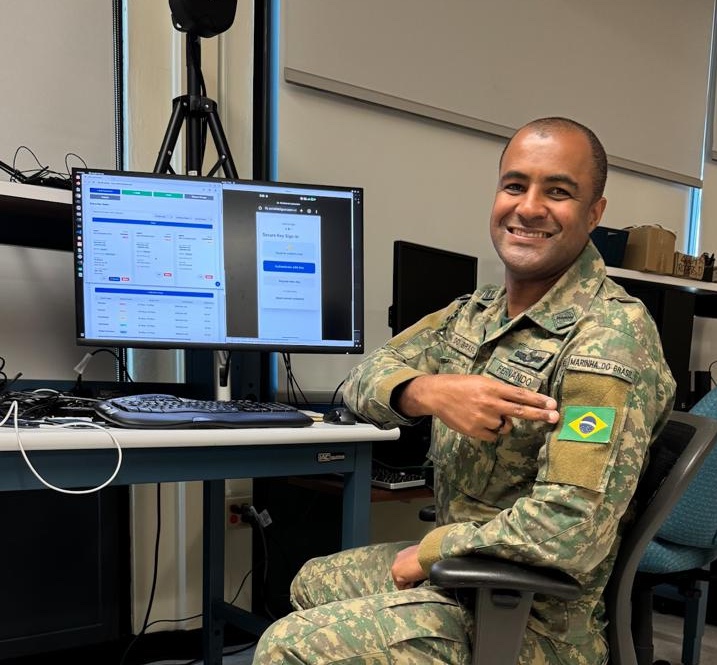
Lieutenant Fernando (Brazilian Navy, Corps of Engineers) is a telecommunications engineer and Brazilian Navy engineering officer who holds a Master of Science in Computer Science from the Naval Postgraduate School (NPS), Monterey, California, with research focused on cybersecurity and access control in private 5G networks. He is married to Annie and is the proud father of two children, Nicolas and Flora. His career combines military engineering service with applied work aimed at strengthening secure communications in mission-oriented environments.
Fernando earned his B.S. in Telecommunications Engineering (2010) and began his technical career in the private telecommunications sector, supporting major mobile network initiatives through network planning, optimization, and performance improvement. In 2015, he joined the Brazilian Navy’s Corps of Engineers, expanding his responsibilities into defense communications and institutional infrastructure while continuing to build advanced technical expertise through formal education and professional development. Alongside military service, he completed a Project Management specialization (2016) and a Master’s degree in Electrical and Telecommunications Engineering (2019), with a dissertation in wireless communications performance and channel characterization. He has also completed a Network Engineering specialization (2022) and professional training in networking and cybersecurity. His academic record includes multiple technical publications and conference presentations, demonstrating a sustained commitment to rigorous engineering work and measurable results.
During his studies at NPS, his thesis work addressed practical security needs in private 5G by exploring how to strengthen user access control in ways that are operationally realistic and defensible. In early 2026, he presented an implemented research prototype, developed with his advisor Dr. Geoffrey Xie, at the Converge@NPS conference and the DON Digital Warfighting Symposium West, highlighting disciplined execution, applied problem-solving, and outcomes relevant to defense and public-sector stakeholders. This research resulted in a novel 5G access control prototype, for which a nonprovisional U.S. utility patent application has been formally filed.
Upon his graduation from NPS in 2026, Fernando’s accomplishments were recognized with two prestigious awards: the Naval Postgraduate School Outstanding Academic Achievement Award for International Students and the Outstanding Thesis Award, reflecting both his academic excellence and the high operational impact of his applied research.
Currently, Fernando's immediate focus is applying his technical expertise to support the Brazilian Navy's ongoing digital transformation. Leveraging the cooperative framework established between NPS and the Brazilian Navy, he is exploring the establishment of a 5G laboratory environment in Brazil to advance secure tactical communications and adapt Zero Trust architectures to operational requirements. Viewing his master's research as the foundation for a broader effort, he intends to continue strengthening scientific cooperation between Brazil and the United States, with the ultimate aspiration of returning to NPS to pursue a Ph.D. and further develop this research at the doctoral level.
The international environment at the Naval Postgraduate School was deeply influential in shaping my academic experience, research approach, and professional perspective. NPS, as a "coalition-building institution" that brings together students from diverse backgrounds, nationalities, and cultures, provided an invaluable global outlook.
This exposure allowed me to learn not only from American culture but also from the unique perspectives, experiences, and goals of fellow students from many different countries. This rich brainstorm of ideas fostered a broader understanding of global challenges and opportunities, which is crucial for any modern naval officer.
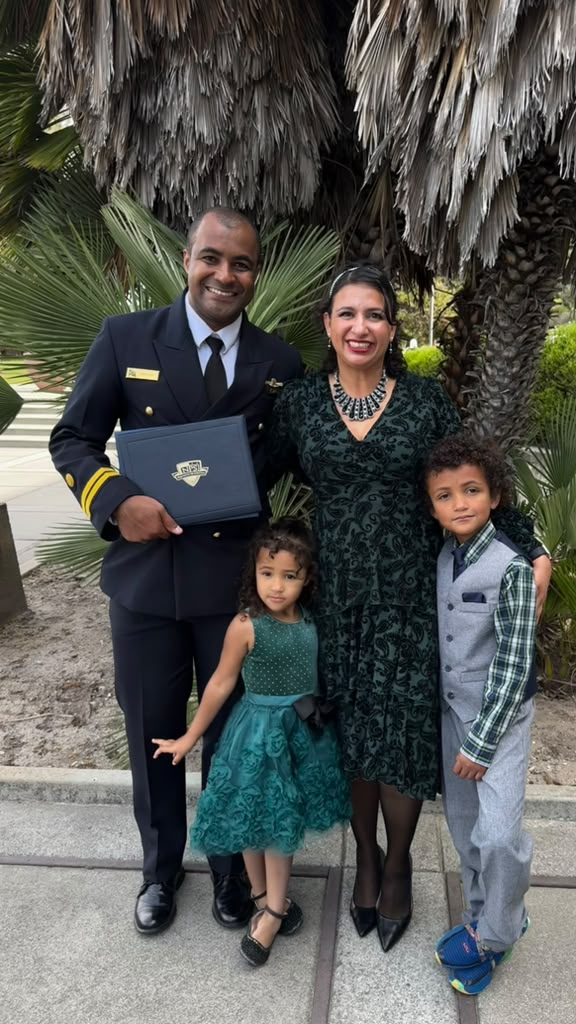
Academically, the diverse perspectives encouraged a more critical and comprehensive approach to problem-solving. I honed my ability to question assumptions and to consider a wider range of solutions based on different points of view. My research approach was similarly enhanced; the collaborative spirit and the exposure to different methodologies and problem-solving styles at NPS encouraged me to be more innovative and adaptable.
Professionally, this international immersion solidified my understanding that effective naval operations and technological advancements often require global cooperation and a nuanced understanding of international contexts. It reinforced the idea that solutions to complex security challenges are rarely confined to a single nation's borders.
I see tremendous opportunities for future collaboration between NPS and international partners that are seeking practical, secure, sustainable, and agile technological solutions to address the rapid evolution of mobile telecommunications networks and emerging operational challenges.
Advanced Research and Development
One of the most promising areas is the expansion of joint research initiatives. My work in 5G network security is an example of how collaborative research can help address emerging operational requirements. I intend to replicate the 5G laboratory environment in Brazil and continue advancing this project while maintaining a strong connection with NPS, supporting future students working in this field, and pursuing opportunities to return for a Ph.D. program. Continuing this research would allow me to expand the applicability of the patent-pending technology developed in cooperation with NPS. The exchange of knowledge and the joint development of critical technologies are essential for strengthening both national and international security.
Joint Education and Training Programs
Expanding exchange programs, collaborative workshops, and specialized courses would create valuable opportunities for students and faculty to share expertise, build professional networks, and establish long-term partnerships. These initiatives strengthen not only technical capabilities but also mutual understanding among allied and partner nations.
Cybersecurity and Emerging Technologies
As military and civilian infrastructures become increasingly dependent on digital systems, collaboration in areas such as cybersecurity, artificial intelligence, and other emerging technologies becomes even more critical. Combining NPS's research expertise with the operational requirements and unique environments of international partners can generate highly relevant and impactful solutions.
The prototype developed through my research, which is currently in the patent process, serves as a practical example of how academic collaboration can produce innovative technologies capable of addressing urgent cybersecurity challenges and supporting the adoption of next-generation communications systems.
Interdisciplinary and Transdisciplinary Research
Many of today's security challenges require multidisciplinary and transdisciplinary approaches. NPS provides a unique environment where bridges can be built across different fields of knowledge, enabling the development of technologies that integrate diverse disciplines in pursuit of technological advancement.
This brings me back to one of the most distinctive characteristics of NPS: its commitment to fostering integrative approaches to education and research. Through an exceptional faculty, a collaborative academic culture, and world-class laboratory facilities, NPS creates the conditions for research that transcends traditional disciplinary boundaries while remaining focused on solving real-world operational challenges. This convergence of knowledge not only drives technological innovation but also enables the development of solutions that are both scientifically rigorous and operationally relevant. Ultimately, strengthening partnerships between the United States, Brazil, and other international allies through NPS contributes to a more secure and interconnected world, where shared knowledge, scientific cooperation, and collaborative innovation play a vital role in addressing the challenges of the future.
Events like Converge @ NPS are essential because they bridge the gap between academic research and operational application. They create a unique environment where innovative ideas are evaluated through the lens of real-world needs, technical feasibility, and practical relevance to contemporary challenges.
For my project, presenting at Converge was a significant milestone. As an international student, having the opportunity to build and demonstrate a fully operational 5G Standalone network testbed within a U.S. military institution was a remarkable achievement. More than presenting a theoretical concept, I was able to showcase a functional prototype for secure tactical communications, demonstrating its practical applicability and potential operational impact.
This experience reinforced my confidence that the research path I had chosen was aligned with real operational needs and highlighted NPS' commitment to an educational model that extends beyond the traditional boundaries of classrooms and laboratories. The institution fosters a culture of applied research, encouraging students to transform academic knowledge into tangible solutions that can generate professional impact, drive technological innovation, strengthen strategic partnerships, and enhance the recognition of academic achievements.
Equally important, events like Converge cultivate a collaborative ecosystem. They bring together researchers, operators, academic institutions, government organizations, and industry partners, creating opportunities to refine concepts, validate solutions, and accelerate innovation. This interaction enables promising research to evolve into deployable capabilities that directly support defense operations and address emerging technological challenges.
Furthermore, Converge demonstrates how the integration of academia, government, and industry can accelerate the transition from innovative ideas to practical solutions. This connection is critical to ensuring that scientific and technological advances do not remain confined to the academic environment but are transformed into real-world capabilities with operational, strategic, and even commercial impact.
The NPS environment is uniquely structured to help students address complex challenges while consistently maintaining a focus on operational relevance. In practice, it builds bridges between theory and application, enabling an interdisciplinary and transdisciplinary approach within a highly diverse academic and cultural setting.
Integration of Theory and Practice
NPS effectively connects advanced scientific education with real-world military application. At every stage, students are encouraged to contextualize acquired and prior knowledge through seminars that open new perspectives on the same subject, while also enabling exploration of innovative pathways for solving operational problems. Courses and research projects are frequently shaped by current operational challenges, ensuring that students develop solutions applicable to real-world environments.
World-Class Faculty and Advanced Research Resources
NPS faculty combine strong academic excellence with extensive operational and defense experience. Their mentorship enables students to conduct research that is both scientifically rigorous and strategically relevant. In addition, access to state-of-the-art laboratories, equipment, and research facilities makes it possible to conduct hands-on experimentation and drive innovation. I would like to acknowledge my advisor Dr. Xei and my co-advisor Dr. Bollmann, who believed in the idea from the beginning, supported its practical development, and validated the feasibility of the patent-pending prototype.
A Diverse International Community
The multinational student body is one of NPS’ greatest strengths. Students bring different operational experiences, cultural perspectives, and approaches to similar challenges. This diversity fosters collaboration, stimulates creativity, and leads to more effective and operationally relevant solutions. As my wife often says, we all arrive as international students searching for the best way to navigate academic life, but we leave with a master’s or doctoral degree realizing that our lives have been transformed—and that we have become researchers eager for new challenges.
My immediate goal is to apply the technical expertise I gained at NPS to support the Brazilian Navy's ongoing digital transformation. Specifically, by leveraging the cooperative framework established between NPS and the Brazilian Navy, I am exploring the possibility of establishing, in accordance with Brazilian Navy directives, a 5G laboratory environment in Brazil. This would allow us to continue advancing secure tactical communications and adapting Zero Trust architectures to meet our operational requirements. Fostering this capability within our Force would be an important step toward strengthening cyber resilience and modernizing military communications.
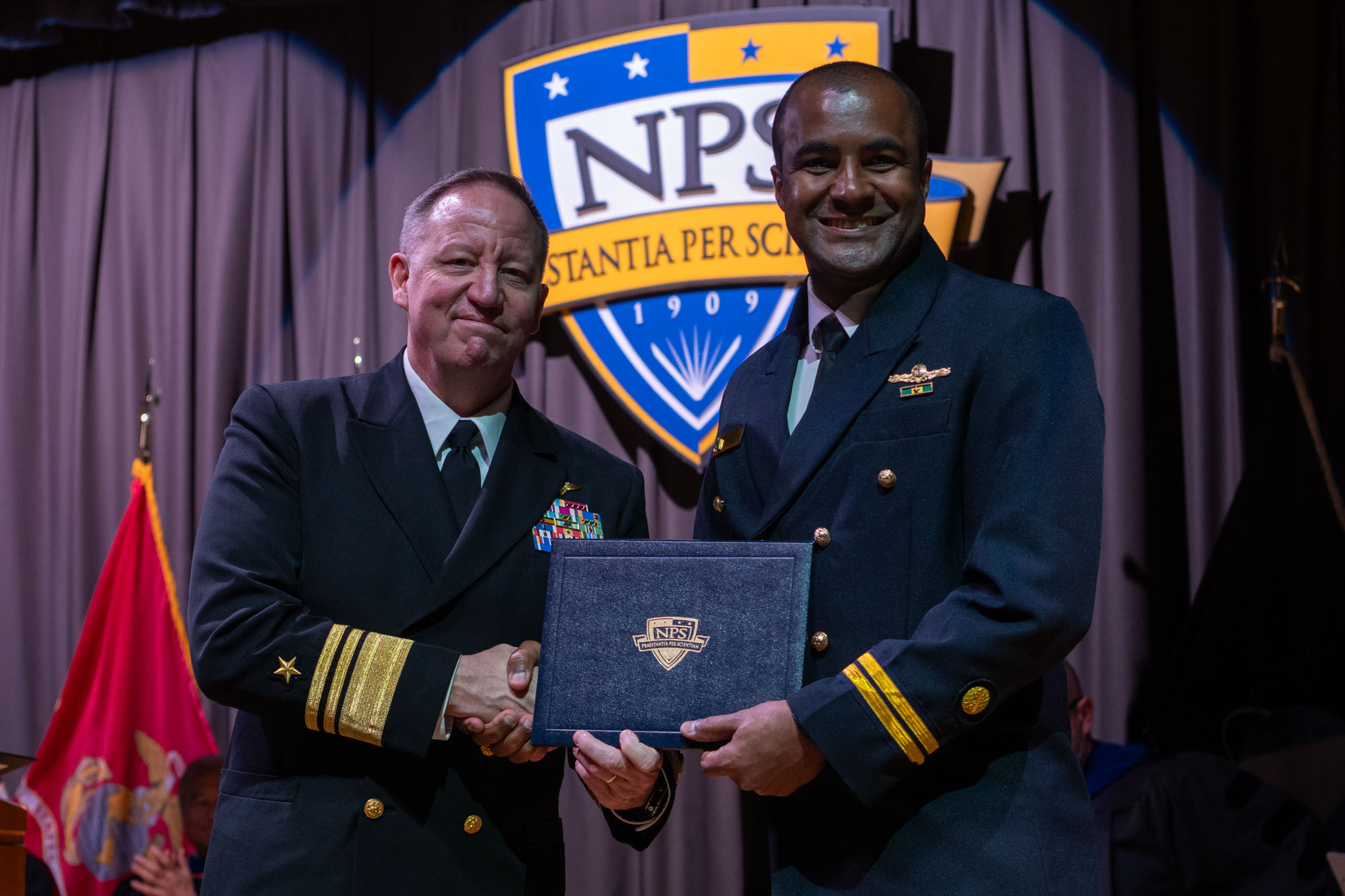
At the same time, I view my master's research as the beginning of a much broader effort. Supported by the mechanisms for continuous, long-term joint research outlined in our bilateral agreements, and in alignment with the Brazilian Navy's strategic priorities, I hope to have the opportunity to return to NPS in the future to pursue a Ph.D. My academic advisors have encouraged me to continue developing this patent-pending research at the doctoral level, and doing so remains both a professional objective and a personal aspiration.
Until then, I intend to leverage the relationships I built with faculty members, researchers, and international colleagues to strengthen scientific cooperation between Brazil and the United States. By actively supporting the initiatives proposed in the NPS-Brazilian Navy Terms of Reference, I hope to ensure that the partnerships and innovations developed at NPS continue to grow and create lasting impact.